Orlando, Florida Commercial Auto Insurance
8:30am - 5:00pm Mon-Fri
Will Reply in 15min*
A catering company sends its branded van to deliver food across Orange County. A landscaping crew hauls mowers down I-4 to a job in Kissimmee. A real estate agent drives her personal sedan between showings in Winter Park. Each of these Orlando-area businesses faces a different set of risks on the road, and each one needs a commercial auto policy tailored to those risks.
Florida's insurance market is shifting in 2026, with the state's
top five auto insurance groups indicating an average rate decrease of 8% this year. That's welcome news for
business owners who've weathered years of
climbing premiums. But lower rates don't mean you can afford to cut corners on coverage. Understanding your liability limits, PIP obligations, fleet options, and
hired-and-non-owned exposure is the difference between a policy that protects your business and one that leaves you exposed after a serious crash. This guide to
commercial auto insurance in Orlando covers each of those areas so you can make informed decisions about your coverage.
Understanding Florida's Commercial Auto Requirements
Florida law treats commercial vehicles differently than personal ones, and the requirements can trip up business owners who assume their personal policy is enough. Any vehicle titled to a business, used primarily for business purposes, or carrying goods for hire needs a commercial auto policy. This applies whether you're running a single pickup truck or a fleet of delivery vans.
The state sets minimum coverage thresholds, but those minimums are dangerously low for most businesses. A single serious accident on the 408 or I-4 corridor can generate medical bills and property damage that dwarf Florida's baseline requirements. Your policy structure matters just as much as having a policy at all.
Personal Injury Protection (PIP) in Orlando
Despite persistent rumors, Florida has not repealed its no-fault PIP system. PIP remains a mandatory part of every auto policy in the state, including commercial ones. Every insured vehicle must carry $10,000 in PIP coverage, which pays 80% of medical expenses and 60% of lost wages regardless of who caused the accident.
The 14-day rule still applies in 2026: you must seek medical treatment within 14 days of an accident to access your full PIP benefits. If you wait longer, your coverage drops to just $2,500 in non-emergency cases. For a business owner whose employee is injured on the clock, that 14-day window is critical. Make sure your drivers know this rule.
Liability Limits for Florida Small Businesses
Florida requires a minimum of $10,000 in property damage liability and $10,000 in PIP. There's no state-mandated bodily injury liability minimum for most private passenger vehicles, but commercial policies typically require bodily injury coverage, especially if you operate for hire.
Here's the reality: $10,000 in property damage won't even cover a fender bender with a late-model SUV. Most insurance professionals recommend at least $100,000/$300,000 in bodily injury and $100,000 in property damage for small commercial operations.
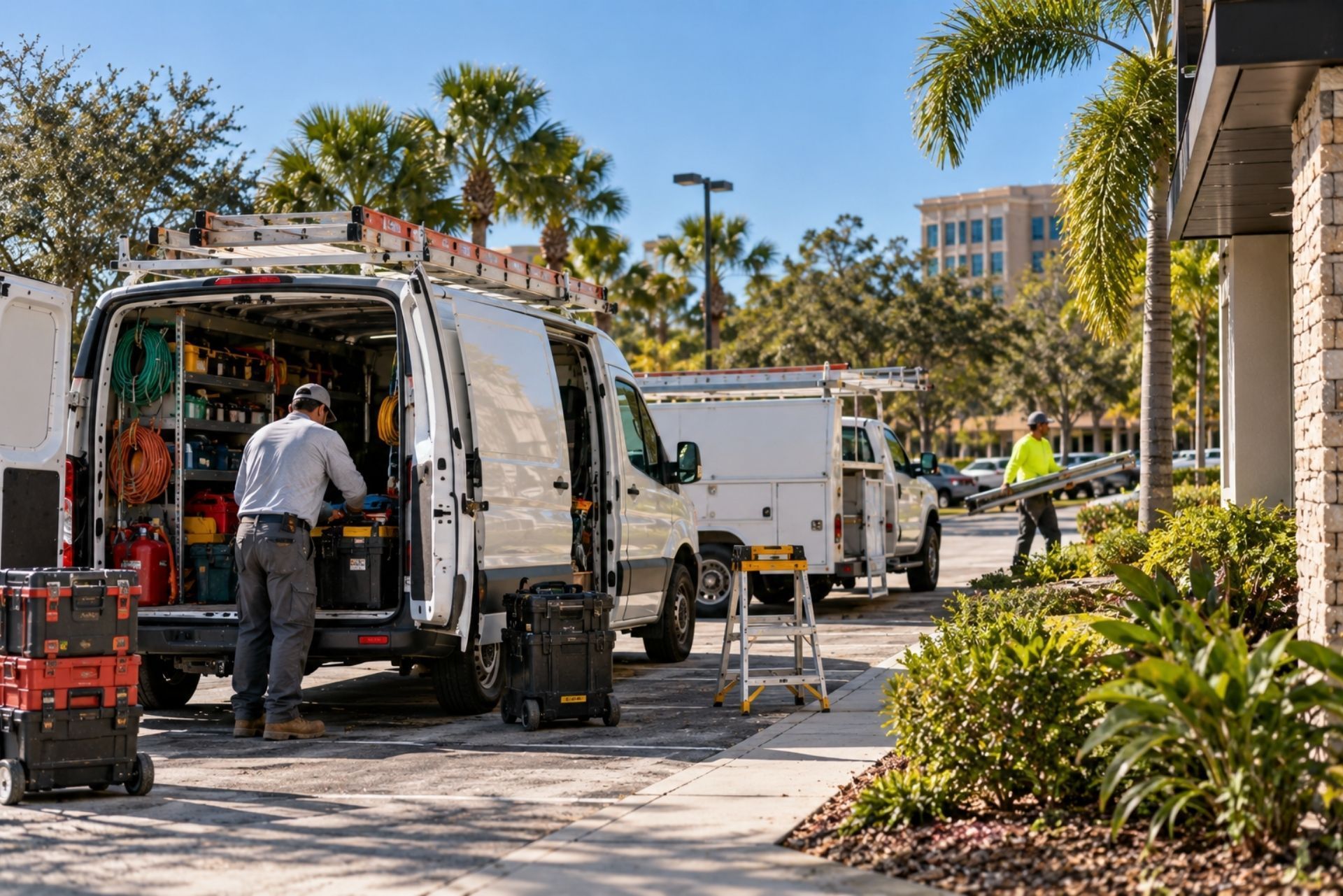
HVAC contractors, plumbers, and electricians who drive heavy service trucks should consider even higher limits. A loaded service van rear-ending a passenger car at 45 mph can easily produce six-figure medical claims.

By: AJ Leibell
President of Bellken Insurance Group
Protecting Assets with Hired and Non-Owned Auto Coverage
This is one of the most overlooked gaps in business insurance. If anyone drives a vehicle on your behalf that isn't listed on your commercial policy, you're exposed. Hired and non-owned auto (HNOA) coverage fills that gap, and it's surprisingly affordable compared to the risk it covers.
Why Employee-Owned Vehicles Need Business Protection
Picture this: your sales rep drives her personal car to meet a client in Lake Nona and causes a three-car pileup. Her personal auto policy covers her, but the injured parties will also sue your company because she was working at the time. Without HNOA coverage, your business has no auto liability protection for that claim.
This scenario plays out constantly in industries like real estate, consulting, and home health care, where employees routinely use personal vehicles for work. HNOA coverage acts as excess liability over the employee's personal policy, protecting your business when the claim exceeds their personal limits or when their insurer denies the claim.
Renting Vehicles for Business Travel in Orlando
Orlando is a convention city. If your team rents vehicles for trade shows at the Orange County Convention Center or client meetings near International Drive, your business faces liability for those rental vehicles. The collision damage waiver from the rental counter doesn't cover liability to third parties.
HNOA coverage extends to rented vehicles driven for business purposes. For a company that rents vehicles even a few times per year, this endorsement typically costs $150 to $500 annually, a fraction of what a single uninsured rental accident could cost. It's one of the best risk-management values in commercial insurance.
Managing Fleet Insurance for Growing Orlando Companies
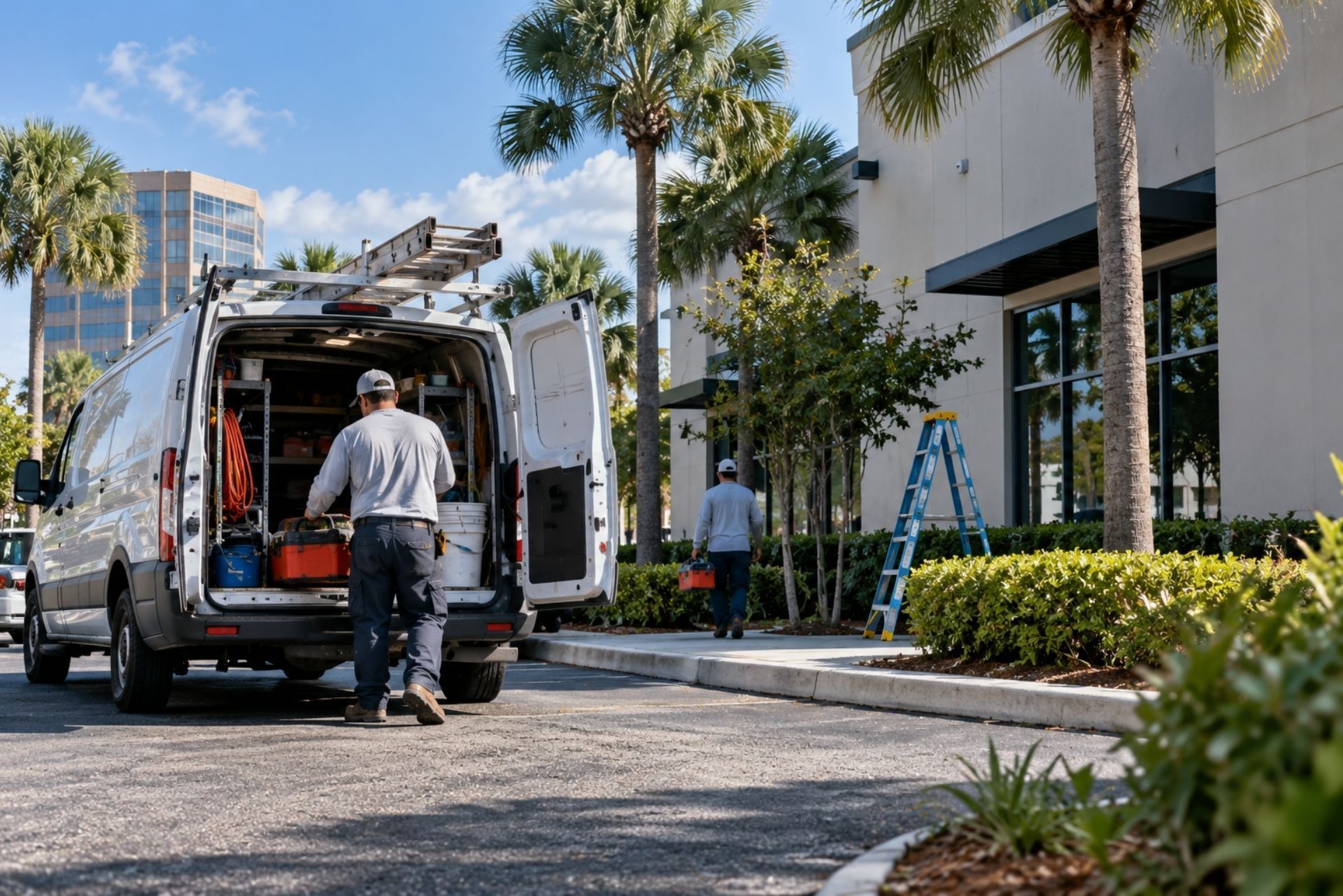
Once your business operates three or more vehicles, you qualify for fleet pricing. Fleet policies bundle all your vehicles under a single policy, which simplifies administration and usually reduces your per-vehicle cost compared to insuring each one separately.
Fleet management in Central Florida comes with specific considerations. The I-4 corridor between Orlando and Tampa is consistently ranked among the most dangerous highway stretches in the country, which means your loss history on that route directly affects your premiums. Telematics devices that track speed, braking, and idle time can earn fleet discounts of 5% to 15% with many carriers.
For growing companies, fleet policies also make it easier to add and remove vehicles throughout the year. A pest control company adding a sixth truck in July or a courier service dropping a damaged van in October can adjust coverage without rewriting the entire policy. Most fleet policies charge on a pro-rata basis, so you only pay for the months each vehicle is active.
Newer vehicles with advanced driver-assistance systems (ADAS) tend to get better rates than older models. A 2025 Ford Transit with automatic emergency braking will cost less to insure than a 2016 model without those features. If you're planning fleet purchases, factor insurance savings into your vehicle selection.
Comparing Coverage: Personal vs. Commercial Auto Policies
Business owners who use a personal vehicle for occasional work tasks often wonder whether they really need a commercial policy. The answer depends on how you use the vehicle, but the differences between the two policy types are significant.
| Feature | Personal Auto | Commercial Auto |
|---|---|---|
| Covers business use | Limited or excluded | Yes, primary purpose |
| Liability limits available | Typically up to $500K | $1M or higher |
| Covers multiple drivers | Named drivers only | Any authorized employee |
| Equipment/tools in vehicle | Not covered | Can be endorsed |
| Hired/non-owned vehicles | No | Available as endorsement |
| Fleet pricing | Not available | Available for 3+ vehicles |
A personal policy will usually deny a claim if the vehicle was being used for business at the time of the accident. If you're a mobile notary, a food truck operator, or a courier, your personal insurer can and will deny coverage for a work-related crash. The premium difference between personal and commercial coverage is far less painful than a denied claim.
Your premium isn't a random number. Insurers calculate it based on a specific set of risk factors, and understanding those factors gives you some control over what you pay.
- Driver MVR (motor vehicle records): Clean driving records across your team are the single biggest factor. One driver with a DUI or multiple at-fault accidents can spike your entire fleet's premium by 20% to 40%.
- Vehicle type and weight: A box truck costs more to insure than a sedan. Heavier vehicles cause more damage in collisions, which means higher liability exposure.
- Radius of operation: A company that stays within the Orlando metro area pays less than one sending trucks to Jacksonville or Miami regularly.
- Industry classification: A florist's delivery van carries lower risk than a tow truck. Carriers price by SIC or NAICS code, and some industries are simply more expensive to insure.
- Claims history: Your three-year loss run is the report card insurers care about most. Two or more at-fault accidents in that window can push you into non-standard markets where premiums are 50% to 100% higher.
The
2026 Florida insurance market is showing some relief after several difficult years, but businesses with poor loss histories won't benefit as much from the broader rate decreases. Investing in driver safety training and dash cameras now can pay dividends at your next renewal.
Common Questions About Orlando Business Auto Insurance
Do I need commercial insurance if I just use my car for deliveries?
Yes. If you're delivering goods or providing services using your vehicle, most personal auto policies exclude that activity. Even part-time delivery drivers for a bakery or florist need commercial coverage or a business-use endorsement at minimum.
How much does a basic policy cost in Orlando?
A single-vehicle commercial auto policy in Orlando typically runs $1,200 to $3,500 per year, depending on the vehicle type, driver record, and coverage limits. Fleet policies with three or more vehicles can bring the per-vehicle cost down by 10% to 20%.
Will my personal PIP cover a work-related accident?
Your personal PIP still applies to you as the driver regardless of whether the accident happened during work. But PIP only covers $10,000 in medical expenses, and it doesn't address your liability to other parties. You need commercial liability coverage for that.
What is the minimum liability I should carry for a commercial van?
Florida's statutory minimum is $10,000 in property damage, but that's woefully inadequate. For a commercial van, we recommend at least $100,000/$300,000 bodily injury and $100,000 property damage. If you're hauling cargo or operating a larger vehicle, consider $500,000 or $1 million combined single limit.
Making the Right Choice for Your Fleet
Getting commercial auto coverage right in Orlando means balancing legal compliance with real-world risk. Florida's PIP requirement isn't going anywhere, your liability limits need to reflect the actual cost of a serious accident, and gaps like hired and non-owned vehicle exposure can sink a business that thought it was fully covered.
The 2026 rate environment is friendlier than it's been in years, which makes this a good time to shop your coverage or increase your limits without breaking the budget. Start by pulling your three-year loss runs, reviewing your driver MVRs, and listing every vehicle and employee who drives for business purposes.
If you're ready to compare options for your Orlando operation, get a quote from an agency that understands Central Florida's commercial auto market. The right policy protects your vehicles, your employees, and the business you've worked to build.
About The Author:
AJ Leibell
As President of Bellken Insurance Group, I’m dedicated to providing clients with clarity, confidence, and protection through personalized insurance solutions. With years of experience serving individuals and businesses, my focus is on building lasting relationships and ensuring every client receives dependable coverage that fits their goals and budget.
Your Personal Insurance Solutions





Choose Bellken Insurance Today
Choice and Transparency
The independent insurance agents are completely different from the insurance company agents. They work for themselves and not for the company. They sell their own policies to the customers and that is why they are called independent agents.
Your Advocate
Independent agents are more inclined to provide you with the best coverage that is suitable for your needs. They can also help you with your budget and make sure that you get the best coverage at an affordable price.
Lifetime expert advice
Independent insurance agents are insurance experts who have a deep understanding of the industry. They are able to clearly explain complex policies or rate changes, and are well-versed in the inner workings of various insurance companies. With years of experience dealing with multiple insurance providers, they are reliable sources of
Our Testimonials
Hear from our clients

This review goes directly to Aj Leibell. Being foreign is not easy to found people that are willing to help you, he was extremely helpful and had so much patience that I can only be grateful. This company trust me, is the best in customer service and prices.
Francisca Diaz Cortez

On behalf of my mom, who dealt with AJ Leibell to resolve an issue. She would highly recommend this agency due to their professionalism, kindness and going over and above what was necessary.
Jessica Moore

Bayview Tower Condo Association is located in Miami, Florida, we are a community comprise of 36 units. Bellken has been our insurance agent for the last 10 years. During all these years our insurance needs have been met by Bellken in a professional and trustworthy manner. The entire staff is courteous, knowledgeable and attentive to detail.
Bayview Tower

We have used their services for over 17 years and are quite satisfied with the support provided. EH
Ed Hays
REQUEST A QUOTE
Get an insurance quote online today!
Get started today!
Speak directly with a Bellken Insurance specialist today!
Prefer to speak with an agent now?